






By Dennis Pollock
Today, we will look at the issue of the laws of Moses and whether any of those laws still count or matter to Christians today. Many Christians would instinctively feel that none of them matter to us at all. After all, does not the New Testament tell us that we are saved by grace through faith in Jesus, and does it not further tell us that the law was nailed to the cross with Jesus? Our job as Christians is to believe, not to keep any set of particular laws, right?
But not so fast. It’s a little more complicated than that. First, there are a great number of Moses’ laws that Christians do not keep, and most Jews today don’t keep them either. In the Book of Leviticus, God told the Jews:
Six years you shall sow your field, and six years you shall prune your vineyard, and gather its fruit; but in the seventh year there shall be a sabbath of solemn rest for the land, a sabbath to the Lord. You shall neither sow your field nor prune your vineyard. What grows of its own accord of your harvest you shall not reap, nor gather the grapes of your untended vine, for it is a year of rest for the land. (Leviticus 25:3-5)
This idea of not planting crops every seventh year called for a radical faith in God, and it turned out that this was one of the most ignored of all God’s commands. The Jewish farmers went right on planting their crops year after year and century after century, never actually keeping this commandment even a single time. They just did not have the faith required to skip a year of harvest and trust God for their needs.
Wearing the Wrong Shirts
Another commandment of Moses that hardly anybody pays attention to, at least nowadays, is the command which insists: “You shall not sow your field with mixed seed. Nor shall a garment of mixed linen and wool come upon you.” (Leviticus 19:19). Maybe keeping each field pure might have been easy, but who, these days, pays any attention to whether their shirt was made from 100 percent pure cotton, or a mixture of cotton, polyester, wool, or anything else?
One of the most famous dietary prohibitions is the command that insists that animals such as pigs are not to be eaten. Now this is a commandment some people take seriously, even today. On my diabetes YouTube channel, I sometimes talk about the metabolic wisdom of eating very low-carb meals, such as eggs and bacon. Occasionally, I get rebuked for eating a food God has condemned. I responded to one such lady by telling her that shrimp and catfish were also forbidden and asked whether she had ever eaten these foods. She replied defensively that, though this was true, pigs were so clearly more abominable than shrimp or catfish. That seemed a little fishy to me!
In Deuteronomy, God commanded His people to make a parapet, a low wall, around their flat-roofed houses to prevent accidental deaths from people falling off the edge. Now that would have been a reasonable law in those days, but who builds a fence around the edges of their roofs today? The answer is: almost nobody.
Sleeping Under Tree Branches
God instructed His people that when they celebrated the Feast of Tabernacles, they were to build primitive lean-tos out of tree branches and live and sleep under them for a full week (Leviticus 23:40-42). I don’t know how many Jews have ever done this, but my guess is very few. And most Christians live all their lives without ever taking a week to live outdoors under a few tree branches during the Feast of Tabernacles.
So, what’s the point? The point is that there are a great many of Moses’ 613 laws, probably most of them, that neither Christians, nor Jews, nor Messianic Jews take seriously. And I am one of them. I can eat bacon and eggs without a twinge of guilt, my roof has no parapet around its edges, and I never sweat it when my shirt is a combination of cotton and polyester. I have never spent a week living under tree branches to celebrate the Feast of Tabernacles, and at my age, I don’t plan to start now.
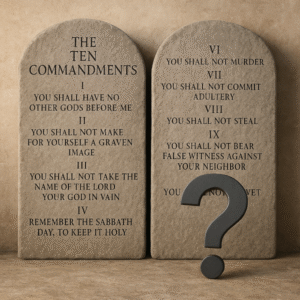
Now, so far, what I have been saying is neither revolutionary nor controversial. The great majority of Jews and Christians would agree with me. But here is where it gets a little more complicated. There are certain other laws of Moses that most of us take a whole lot more seriously. The ultimate example of this would be the ten commandments, or at least nine of the ten (excluding the Sabbath commandment). These, like all the other laws mentioned earlier, came from God through the mouth of Moses. Most Christians and most Jews would say the prohibitions against killing, stealing, and adultery are still very much relevant to us today. And I agree.
So how is it that some of Moses’ commandments are still very much “on the books” while others are ignored by almost everyone? And the answer is that there is a great difference between ceremonial, cultural, and dietary laws, as opposed to the moral laws. And if you ask, how can we discern between which laws are moral laws and must be obeyed, and the ceremonial and dietary ones we can neglect, the answer is simple: Any of the Old Testament laws of God that are binding on Christians are repeated in the New Testament. Murder, adultery, stealing, and lying are condemned in the Old Testament, and they are also condemned in the New Testament.
Don’t Let Others Judge You…
Paul writes: “Let no one judge you in food or in drink, or regarding a festival or a new moon or sabbaths, which are a shadow of things to come, but the substance is of Christ.” (Colossians 2:16). These are Jewish ceremonial and dietary laws, not moral laws. If I am sleeping peacefully in my house during the Feast of Tabernacles and someone knocks on my door and tells me I am a terrible sinner for not sleeping under a lean-to outside my house, I would tell them not to judge me – I am free in Christ. If I am mowing the lawn on a Saturday afternoon, and my neighbor tells me I will go to hell for breaking the Sabbath, I would have a pretty strong argument with that.
But on the other hand, if I have just robbed a bank and my Christian friend rebukes me for stealing, I would have no defense. Stealing is just as wrong today as it was in Moses’ time. In the book of Revelation, the sinners of those days are condemned with these words: “And they did not repent of their murders or their sorceries or their sexual immorality or their thefts.” (Revelation 9:21). These folks are clearly guilty breaking the laws of God, and even though this is in the New Testament era, these laws are apparently still on the books.
Some people would not be comfortable with this. They would argue: “We are saved by grace through faith in Jesus, so there are no laws for us to keep.” They are right and they are wrong. We are indeed saved by grace through faith in Jesus, but whoever told you there are no laws of God for us to keep? Not Jesus, not Paul, and not John. Read the New Testament. You will find that there are all kinds of laws given to believers. We are not saved by keeping them; we are saved by faith in Christ. But once we are saved, we are given a new nature that passionately desires to please our Heavenly Father. And when we begin reading in the New Testament, we find exactly how God desires His children to live. And He is so emphatic about the lifestyle He insists upon; He tells us if we do not adhere to this lifestyle, it is because we are not truly His children. Our faith is spurious.
So, pick up your Bibles my friends and discover the lifestyle your loving Heavenly Father desires for you, and what He expects of you. And in the power of the Holy Spirit who lives within you, begin to live out that life the Scriptures lay out for you. “For it is God who works in you both to will and to do for His good pleasure.” (Philippians 2:13).