






by Dennis Pollock
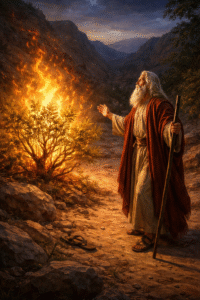
Every Christian has read or heard the story of Moses seeing the burning bush that was not consumed and then being called by God to go and liberate His people from the Egyptians. Moses was no doubt more than a little startled, but even more amazing was the voice that he heard and the words that voice uttered. The Bible tells us:
Then He said, “Do not draw near this place. Take your sandals off your feet, for the place where you stand is holy ground.” Moreover, He said, “I am the God of your father–the God of Abraham, the God of Isaac, and the God of Jacob” (Exodus 3:5-6).
God not only revealed Himself to Moses by His voice; He gave him His own identification. This was not just the voice of an angel or a spirit; this was the voice of the Creator of all things, and He was the same God who had spoken to Moses’ forefathers, Abraham, Isaac, and Jacob. At some point during his days as a prince in Egypt, Moses learned that he was not an Egyptian. He was a Hebrew. He knew who his mother was and got to know his brother, Aaron, and his sister, Miriam.
But why would this idea of this voice being the God of Abraham, Isaac, and Jacob mean anything to Moses? Keep in mind that in those days there were no Bibles. Moses himself would write the first five books of the Bible, but that would happen years later. At this point, all the Jews had to instruct them and remind them of their God were stories that were told and repeated from parents to children, from generation to generation. And the major story that bound them together was the story of a man named Abraham who heard a mysterious voice of God, instructing him, guiding him, and making promises to him. And this same God also spoke to his son, Isaac, and to his son, Jacob.
Obsessed
These men had lived around four to five hundred years before Moses, but the Jews were almost obsessed with these three men, Abraham, Isaac, and Jacob, and their life stories. They loved to hear and talk about the invisible God who spoke to them, and these stories were at the heart of their religion and their identity. Thus, when God identified Himself to Moses as the God of Abraham, Isaac, and Jacob, Moses knew who this was. He was the one true God who made up the essence of Hebrew history and experience. And now He was speaking to him, all these centuries later!
This God of the Hebrews was radically different from the “gods” of all the peoples of those days. All the other nations and peoples had idol gods that you could see, feel and even carry from place to place. But the God of the Hebrews could not be seen or touched. And the only way he was known was by His voice, a privilege given to Abraham, Isaac, and Jacob. The Jews of Moses’ day had never heard this voice, but they believed the stories and were convinced that the three patriarchs of Israel had truly heard Him and believed the record and the stories that had come down to them from many generations previously.
This mysterious God was once again, after hundreds of years, talking to a man, revealing Himself and His will. In fact, by the time Moses’ life came to an end, God had spoken to Him far more often and more clearly than He ever did to Abraham. The Bible tells us: “But since then there has not arisen in Israel a prophet like Moses, whom the LORD knew face to face (Deuteronomy 34:10).
The Term Endures
Even still, God’s official identification, the term He is most known among His Jewish people, is “the God of Abraham, Isaac, and Jacob.” Just before Moses died, he told the people of Israel:
See, I have set the land before you; go in and possess the land which the LORD swore to your fathers–to Abraham, Isaac, and Jacob–to give to them and their descendants after them (Deuteronomy 1:8).
And when Peter was preaching to His Jewish brothers and sisters on the Day of Pentecost, he announced: “The God of Abraham, Isaac, and Jacob, the God of our fathers, glorified His Servant Jesus, whom you delivered up and denied in the presence of Pilate, when he was determined to let Him go” (Acts 3:13).
In our world, there are many ideas about God. Every religion has its own view of the nature of the Creator, and none of them are alike. If any person asks the question, “What is God like?” He has thousands of preconceived ideas from which to choose; however, these views of God differ radically from small points to big ones. If a person wants to worship God, he or she would do well to know something about the God they worship. But which one of all the hundreds and thousands of perspectives related to Deity, shall we embrace?
There were three men: Abraham, Isaac, and Jacob, who claimed that the voice they heard and the God who spoke to them and directed their lives was the only true God. And the Jewish religion finds its roots in these men, with the Jews and the Christians believing that they had the exclusive and true revelation of their Creator. When Moses came along, he added much to the knowledge of God, but he was not starting from scratch. He was simply expanding on the knowledge of that mysterious Being who spoke to men who lived centuries before Him. And thus, when God appeared to Moses, He announced Himself as the God of Abraham, Isaac, and Jacob.
Jesus & the God of Abraham
Many years later, when Jesus appeared on earth, He fully recognized this God. He told the Samaritan woman He met at the well: “You worship what you do not know; we know what we worship, for salvation is of the Jews” (John 4:22). Jesus was declaring that the true knowledge of the only God could exclusively be found in the sacred Scriptures of the Jewish people. Of all the religions and philosophies in the world, then and now, the only way you will get to know the one true God is to become familiar with the Jewish people and the Jewish writings that we call the Scriptures. Like Moses, Jesus did not come to start something new, but rather to complete what God had begun when He first began speaking to an ancient man named Abraham, and then to his son Isaac, and his grandson Jacob.
But in the New Testament writings, we find another term for God. Although He is called the God of Abraham, Isaac, and Jacob a few times, the more common New Testament title is what we find in so many of Paul’s letters. In Ephesians, he writes:
Blessed be the God and Father of our Lord Jesus Christ, who has blessed us with every spiritual blessing in the heavenly places in Christ… (Ephesians 1:3).
The God we know and love today is surely the God of Abraham, Isaac, and Jacob, but He is also the God and Father of our Lord Jesus Christ. Learning about Abraham but knowing nothing about Jesus is not good enough. Becoming acquainted with Moses and the ten commandments but being ignorant of or neglecting God’s only begotten Son, Jesus Christ, is woefully inadequate. The fullness of what God began when He first spoke to Abraham so many thousands of years ago has been completed through the life, death, and resurrection of our Lord Jesus. And this, of course, is why God told Abraham so long ago: “In your seed all the nations of the earth shall be blessed…” (Genesis 22:18).