





By Dennis Pollock
The Scriptures tell us that Jesus “came to His own, and His own did not receive Him” (John 1:11). He wasn’t quite sure what the Jews were expecting. He had no interest in defeating Rome, He had no qualms in ignoring Pharisaical rules not based on Scripture, and He had the alarming habit of calling Israel’s religious leaders “hypocrites.” While all Israel looked eagerly for the Messiah, the consensus among the nation’s scholars was that this Galilean peasant most definitely wasn’t the One. They had never been more wrong.
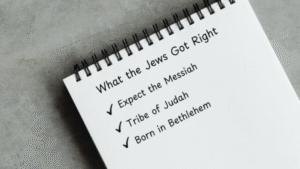
We must recognize that the Jews did not completely miss the mark in their study of the Messianic prophecies. As they studied the prophets and attempted to draw prophetic conclusions from their writings, they did get some things right. From our New Testament perspective, we can recognize three major prophetic truths that the Jewish prophetic scholars correctly discerned. Let’s look at three of these insights.
First, the Jews understood that a Messiah was coming. By the time Jesus had come along, most of the Jews were eagerly waiting for the Messiah. We read in Luke:
Now, while the people were in a state of expectation and all were wondering in their hearts about John, as to whether he might be the Christ… (Luke 3:15).
When John arose in Israel as a powerful preacher of righteousness, the people immediately began to wonder if he might be the Christ. “Messiah fever” spread all over Israel. In synagogues throughout tiny Israel, teachers of the sacred writings were encouraging their congregations that a Messiah was coming who would “redeem” Israel. John’s powerful, anointed ministry was enough to make the multitudes begin to think he might be that anointed one. John was quick to dispel such notions and declared he was merely the forerunner of Christ.
Even the despised Samaritans recognized this truth. When Jesus conversed with the Samaritan woman at the well, she told Jesus:
I know that Messiah is coming (He who is called Christ); when that One comes, He will declare all things to us (John 4:25).
This Samaritan lady may have been no theologian, but she was certain of two things: 1. The Messiah was coming, and 2. He would tell them all they needed to know. She was exactly right.
The Jewish scholars, because of lengthy study and discussion, had accurately discerned that God would send them an “Anointed One” who would deliver Israel. Of the nature of that redemption, they weren’t sure just what the Messiah would accomplish. It was strongly debated, but most Jewish scholars agreed that the Messiah was to come!
Two of the Scriptures they had discovered would include:
The Lord your God will raise up for you a Prophet like me from your midst, from your brethren. Him you shall hear (Deuteronomy 18:15).
For unto us a Child is born, unto us a Son is given; and the government will be upon His shoulder. And His name will be called Wonderful, Counselor, Mighty God, Everlasting Father, Prince of Peace (Isaiah 9:6).
They had read these and other verses, had decided that they meant just what they said, and had drawn a reasonable conclusion. Messiah was coming! A second prophecy that the Jews understood was that this Messiah would be from the tribe of Judah and would be a descendant of David. It is significant that Matthew begins his gospel with the words: “The book of the genealogy of Jesus Christ, the Son of David, the Son of Abraham” (Matthew 1:1). Matthew, who fills his writings with references to the Old Testament prophecies, wastes no time in establishing that this Jesus he writes of had the proper Messianic credentials.
It was common knowledge in all Israel that the Messiah would be a “son of David,” from the tribe of Judah and descended from the royal Davidic line. This immediately eliminated most Israelites. There were twelve different tribes from which the Jews had descended. An Ephraimite wouldn’t do; a Benjamite was unacceptable. Any who would claim to be the Messiah would have to be from the tribe of Judah and have David as an ancestor.
We see this in several places in the Scriptures. As Jesus walked, we read: “Two blind men followed Him, crying out and saying, ‘Son of David, have mercy on us!’” (Matthew 9:27). They called Him “Son of David” to express their confidence that He was indeed God’s promised Messiah.
Matthew records another illuminating event:
Then one was brought to Him who was demon-possessed, blind and mute; and He healed him, so that the blind, and mute man both spoke and saw. And all the multitudes were amazed and said, “Could this be the Son of David?” (Matthew 12:22,23).
They were asking whether Jesus could be the Messiah. To them, “son of David” was another way of referring to the Messiah, so sure was their confidence that the Scriptures predicted this very thing.
When Jesus rode a donkey down the Mount of Olives, the crowd joyously proclaimed, “Hosanna to the Son of David! Blessed is He who comes in the name of the Lord!” (Matthew 21:9). The “son of David” was the Messiah, and the Messiah was the “son of David.” The Jews may have been ignorant of many aspects of the Messiah’s nature and ministry, but they got this one thing right. They knew his family tree!
The Jewish students of the prophets had taken God at His word and drawn the only possible conclusion: when the Messiah arrives, He will come from a family that can trace their lineage back to King David. He will not be from Dan, Gad, Reuben, or any of the other tribes. He will be from Judah, through the line of David. They were not wrong.
Born in Bethlehem
The Jews knew there would be a Messiah, that He would descend from David, and they knew a third thing. They knew the very city in which He would be born.
When the wise men came to Herod to inquire about the newly born King of the Jews, Herod sent for Israel’s finest Bible prophecy scholars. His question was simple: “Where would the Messiah be born?”
Israel’s finest Biblical minds did not have to ponder long on this. Herod had lobbed them a theological softball. Everyone knew the Messiah would be born in Bethlehem. Matthew records:
And when he had gathered all the chief priests and scribes of the people together, he inquired of them where the Christ was to be born. So, they said to him, “In Bethlehem of Judea, for thus it is written by the prophet: ‘But you, Bethlehem, in the land of Judah, are not the least among the rulers of Judah; For out of you shall come a Ruler Who will shepherd My people Israel.’ (Matthew 2:4-6).
These scholars hadn’t learned this truth through any kind of mystical revelation or complex Biblical formula. They had simply read the prophecy from Micah, took it at face value, and believed that it would be fulfilled just as it read.
See how narrow these three simple prophecies have become. First, we learn that God will send a Messiah, an Anointed One, to His people Israel. Second, we learn that this mighty Deliverer will be a descendant of David and of the tribe of Judah. And third, we discover that He will be born in the town of Bethlehem.
This thinned out the field enormously. There weren’t many descendants of David’s in those days (or before or since) who were born in Bethlehem and showed the least promise as a potential Messiah. Had the Jews paid a little more attention to their own limited prophetic understanding, they should have given Yeshua, who possessed all these qualifications (along with the ability to raise the dead, heal the sick, and walk on water), a little more serious consideration.
Jesus Christ was and is Israel’s promised Messiah, the Son of the living God. There are no other possible candidates born in Bethlehem and descended from King David. God has made this truth so plain, incontrovertible, and undeniable that any person who ever bothers to open the Hebrew Scriptures and read for himself will see it, if his heart is not clouded by bias. God has made it plain, from the Scriptures and understood even by the Jews’ own theologians, that the only possible Messiah of Israel, throughout the entire history of its existence, is Yeshua of Nazareth. And this confirms that simple but powerful truth: “God so love the world that He gave His only begotten Son, that whoever believes in Him should not perish but have everlasting life.” (John 3:16).